The easiest way to determine factions would be to simply split them by location, or world history.
Then, the conflict could revolve around gaining or maintaining territory, and that could include groups being pushed out of their original territories and then trying to take them back.
You can also split it by the each of the area’s history, using previous conflicts to shape the factions, i.e. political ones.
The Characters ready!
Build your factions around your characters’ core beliefs.
What do your characters care about? What is their worldview? What about the opposite?
With a focus on the characters, the creation of the factions can become integral to your OC’s story. Will they need to grow out of the faction? Will the faction grow and change as the character does? Will they leave one for another as their story moves forward?
And conversely: what does being in that faction say about the character? What does a monster being in a Hunter’s faction, for example, say about the monster? Are they guilty? Do they doubt their identity, or are they a wolf in Sheep’s clothing waiting to strike?
Video Games have long graduated from simple fights between good and evil. Games are now tied with intricacies and multiple sides, each believing that they are the ones that are correct.
The question now becomes “How do I put that into my game?”. As with my other articles, there are multiple ways to go about this!
It is best to begin at the beginning!
I want to start with the factions…
The Question to ask here is “Why are there factions in the first place?”
Usally a group splits over an arguement; as creator, you decide what kind of disagreement causes the breakup.
What do people believe in enough that their goals and ideals split? Is it something simpler, like a land disagreement or a family squabble? Are the factions gunning for power, splitting politically? Are the factions after a superweapon, an their reasons for wanting it are causing the divide?
In this way, the creation of the factions and therefor, their very existence drives the story.
Emphasis
By creating them first, it puts more emphasis on them, rather than other aspects. This works in your favor if you want to use your story to explore methodologies or philosophies, and what causes people’s differences.
Having factions be at the center of your story allows for discussions with lines drawn in the sand, and it’s up to you (or your players) to decide if they stay, move, or fade entirely.
Effect
A good way to gauge how much your factions affect the story you’re creating is this:
What happens if something about the faction changes?
If destroying the faction of choice does nothing, then it has no impact on the story. This isn’t necessarily a bad thing: If it impacts the World or the characters, it can stay! Asking this question can help gauge how much you want to focus on that faction. If it’s deemed insignificant, than you can skim over it, or maybe change your story if you’re really attached to the idea of it.
What does the faction add to your story?
As mentioned above, if the addition of this faction bolsters other parts of your story, it should stay in. Depending on how much it affects the rest, you can draw the players/readers attention to it by having the story be more closely tied to the factions.
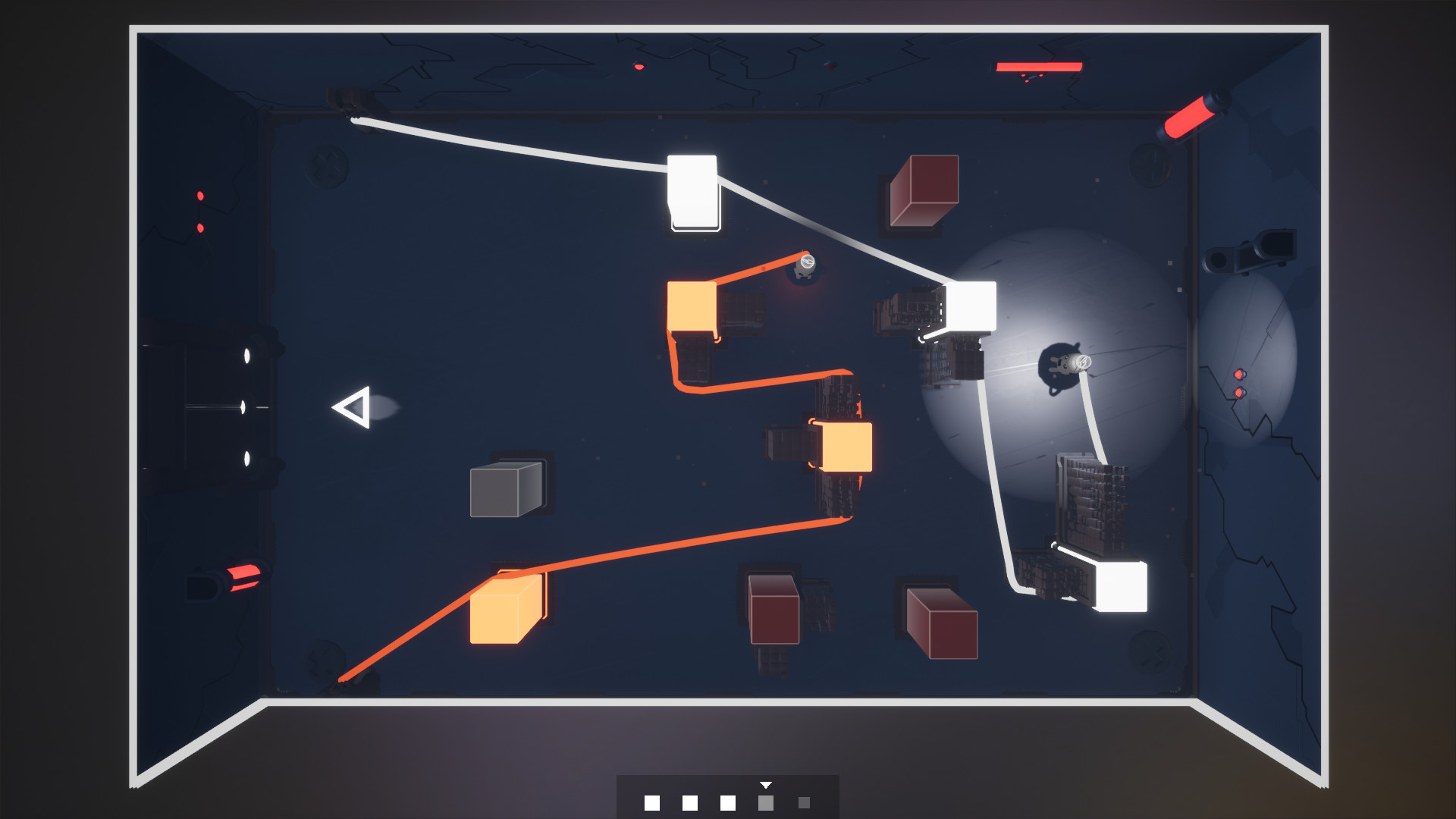
Filament (released back in April of 2020) is a sci-fi Puzzle game with a story thread running throughout.
In Filament, you explore the ship and its crew while solving delightfully colorful puzzles.
The game is known for its notorious difficulty, but even as those that review it flounder, they insist that the story and aesthetics make the game worth it.
Filament looks gentle on the eyes, the brightly colored (and titular) filament and the poles are high-contrast, and don’t get lost in the background.
Any piece taken by you becomes your piece. You can then drop onto your side of the board in any free location, at any point in time.
Difficulty: Just above average chess; 5.5/10. The difficulty is now in placement and knowing gthe consequences of losing a piece.
Fun: 10/10!!! Rub salt in your enemies wounds by using what they lost. Adds an additional boost to eating and really reinforces the consequences of losing pieces.
Edits to be made: Have an extra set of pieces set aside for use.
Dark/Fog of War Chess:
Your opponent’s moves and pieces are not visible. Pawns, who’s movement may be blocked by a piece will be informed that a move forward is an illegal move- on this point some variety is seen on informing players, as some versions have an umpire who can decide on whether they announce what piece has moved or where it may be moved to.
Difficulty: Extreme: this style of game play requires knowledge of common moves and tactics. It works best for people who know how to play, and play well. 10/10.
Fun: If you like puzzle games and riddles, and deductive reasoning, this is the variation for you. If you love battleship, this is perfect.
Edits to be made: For an in-person game, this version would require 3 boards (you, opponent, 3rd party) and an umpire (to decide legality of moves).
Omega Chess:
Two pieces are added: The Wizard moves 1,3 or 3,1. It’s placed in the corners of the board, starting just off it. The Champion can either jump 2 diagonally, or move up to 2 horizontally or vertically, reminiscent of Chaturanga.
Difficulty: With a larger board and two new pieces, I feel the difficulty will be found in learning and adapting to the new pieces over anything else. 6/10.
Fun: Yeehaw WIZARDS!!!!!!! The names of the new pieces and the added gameplay gives this version a 7.5/10.
Edits to be made: 10×10 board, 4 additional pieces per side (2 wizards, 2 champions)
Cannibal Chess:
Difficulty: Definitely on the higher end: Remembering all the pieces that were eaten, and by whom, and doing so for your opponent as well is hard. A good way to train one’s memory!
Fun: Perfect opportunity for obnoxious munching noises during gameplay. 10/10.
Edits to be made: None to the board or pieces themselves. I would recommend marking the figures with some sort of symbol and then writing out which ate what on a sheet of paper.
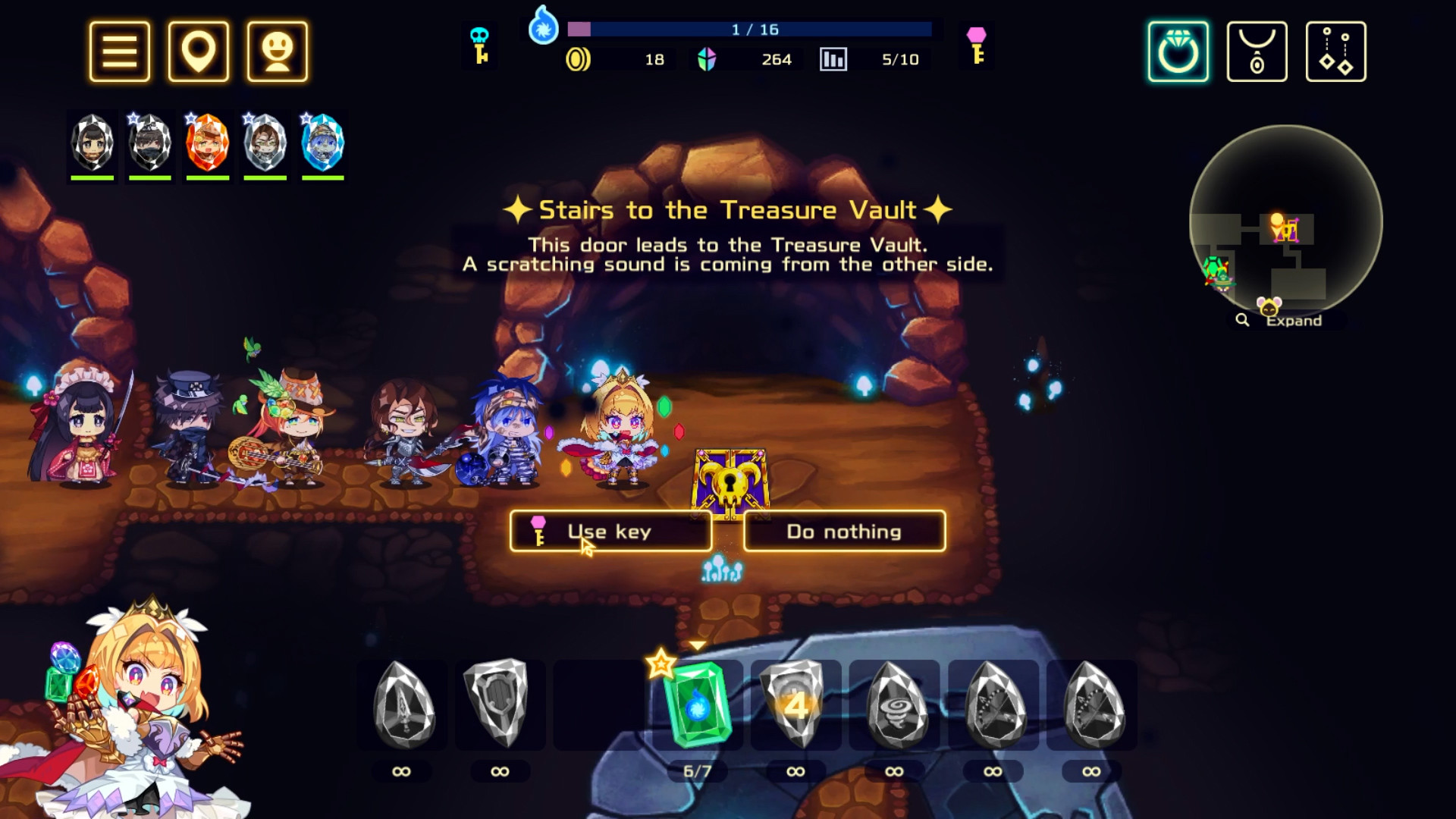
This Upcoming game on Steam has all the cuteness of a mobile game paired with the dungeon crawl adventures found in early MMOs.
Vivid Knight fits its name and reunites the modern gatcha with it’s fantasy-based ancestor (the MUD).
It’s character designs (varied and colorful as the name implies) works well with the graphics that accompany the randomly-generated dungeons that are the base of the game.
Mixing and matching the crystals that represent characters let you fight mobs and move through the dungeon, moving your party and the story along.
Vivid Knight’s building on the respected genre of dungeon crawler may revive the fun that nerds in ages past have enjoyed for themselves, and bring the 8-bit style of game into a new era.
Overall Aesthetic: The gems and art style are cute, with good color choices!
Gameplay: As someone who like randomized dungeons, this is one that drew my eye: I like how some rooms are optional, and if you don’t want to do something, a whole bunch of room types have option to not engage.
For a relatively simple game, Jury box (published in 1936 by Parker Brothers) has earned itself a spot in game history.
It’s a game for any number of players, and is relatively simple. You (and your fellow players) act as jury to the cases provided in the box. There is photo evidence, an illustrated case file, and what the “correct” answer.
In play, after the case is read by a selected player, the players write their verdict and idea of what happened: points are awarded to those with the correct verdict, and to those whose solution behind what happened comes closest. The person with the most points after all the cases are complete wins.
Jury Box is the precursor to modern variations of LARP and murder mystery games.
The action of pretending to be a person, and the whodunnit nature of the game is what lead to the evolution of games like Clue and such.
Sometimes, research turns into something else entirely.
Yesterday, as I was researching more historical board games for a few other artcles, I came upon a website that sold a few dozen physical variations on chess. It not only caugfht my eye, but also sent me on a fun wikipedia dive.
Today, I’ll be rating different chess variations by aesthetic, readability, and how much they made me want to play that particular variation.
3-person chess (Hexagonal)
Aesthetic: 10/10 a blast to boggle at. The squares merging in the center is incredibly pleasing.
Readability: 10/10: clearly readable!!! Lovely.
Want to Play: 10/10 YES. Wish I knew more people IRL who liked chess to play this version of the game!
3-person chess (circular)
Aesthetic: 10/10 a joy to look at, makes a fun centerpiece, will fit on a circular table and not look ridiculous.
Readability: 4/10 Makes my eyes hurt: The board tries to be more readable by adding diagonal lines through the squares, but I feel that makes the board even more confusing to try to decipher in a game. It looks cool, sure, but doesn’t do well for play. the colors for the pieces are standard, I suppose, but better choices could have been made.
Want to Play: 5/10 Due to the board, it’s not high up on my play list, regardless of how cool it will look on a coffee or café table.
Stacked Chess
Aesthetic: Not so much for me: a 6/10. The boards and pieces are very standard, and while the connecting spire adds a bit of flair, it doesn’t do much for the look. The pieces look cheap.
Readability: The individual boards are perfectly readable, 10/10, this is what standardization is good for.
Want to Play: ehhhhh *wiggle hand in a so-so manner* 4/10. If I wanted to do something like this, there’s quite a few digital versions which do a better job with the concept of multiple boards, one of which is “5D chess with multiverse time travel“.
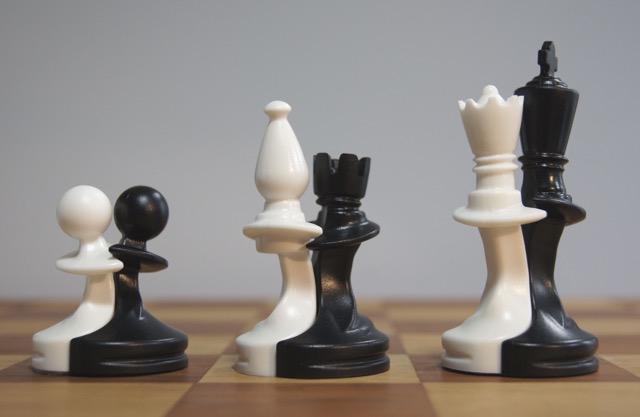
Peace Chess (Paco Sako)
Aesthetic: Cute!!! I honestly love the way the piece designs were modified for the new gameplay. 10/10
Readability: 10/10: standard board, and the pieces retain enough of their silhouette to remain distinctive.
Want to Play: 6.5/10. The concept of “peace chess”, in which the kings try to reach each other by jumping through other pieces is enough to warrant a try, but I’m not entirely sure about the replayability. Since you can’t take pieces off the board, I feel that there’s not many moves to h=be had after a few plays.
Jester Chess
Aesthetic: Overall, really standard: other than the titular piece and extra spaces, nothing else is added, visually. 5/10: it works, I guess.
Readability: Looks Just like your average chess board but with more squares: it’s a 10×10 black and white board. The pieces are the same as your average ones, with the exception of the added, titular piece: the Jester. 10/10. Unique piece design, recognizable board.
Want to Play: Definitely intriguing! The added piece (whose rule for movement is literally “whatever piece your opponent just moved”) would add interest to your usual game, with extreme annoying sibling energy attached. Prefect for people who want to aggravate their family, 8.5/10.
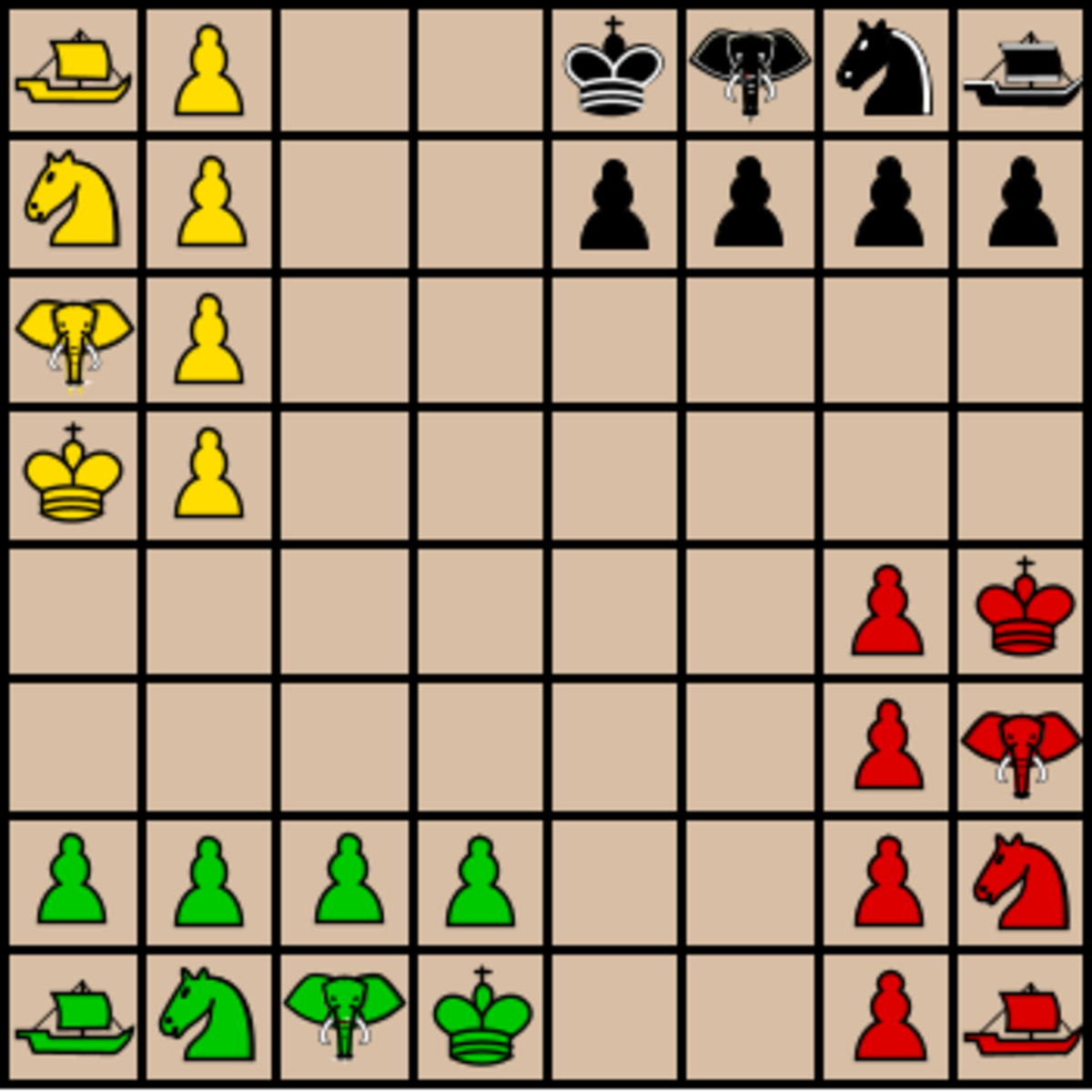
This game from 6th century India is believed to be the ancestor of chess and other games (worldwide!) like it.
There are a few things that set Chaturanga aside from modern chess. For one thing, unlike modern chess, this game can be played with up to 4 players. In 750 CE, this version of chess reached China, and by the 11th century it had come to Japan and Korea. It went through Persia and into Europe around the same time.
The theory of the game’s spread revolves around the Silk road, an ancient trade route spanning from Italy in Europe to Xian in China. This trade route moves through land and sea, and facilitated trade of all kinds.
It’s due to the silk road that it can be hard to determine the origins of chess, as pieces simular to what we know have been found all over 3 different continents.
Like other ancient games, some of the rules are up to speculation.
What we know about the rules and play:
Of the pieces that we know of today, the rook, knight, pawn and king move the same. However, The kings do not face each other (aren’t in the same column), and the pawns don’t have the option to move 2 spaces on their first move.
The Queen was the Counselor, and could only move 1 square diagonally. The Bishop was the Elephant, and could only move 2 spaces diagonally.
One of the theorized rules is that the pawn, instead of automatically becoming the Queen/Counselor, would actually become the piece that occupied that square in the beginning.
Chaturanga was won by what we know as checkmate, or by eliminating all pieces except the king.
Castling and En-passant weren’t introduced until the 15th century, and the checkerboard pattern we associate with Chess was only introduced as decoration around the year 1000.
What I found to be interesting, was that in the 4 player version of Chaturanga, what piece you played was determined by dice throw, which completely change the flow of the game. The dice is a D4, and the sides are as follows: The Raja (king) and pawn, the knight, the elephant (bishop), and the boat (rook). The four player, as you can see, does not include the Counselor.
Where to play?
You can buy physical boards around the internet, or just use a regular chess set, and modify the rules.
You can play online here, but you have to sign up, and there are a few apps that allow multiplayer versions of the game.
A game like this, from 2600 BC, is full of intrigue. This delicately carved block of stone, with flowers and markings etched into the rock, sings to played again.
A 4×3 board is connected to a 2×6 board with 2 squares. There are 4 d4’s, with dots on 3 of the points. And there are 7 Tokens per player, with one blank side, and one side with 5 dots
We have the board, the dice the pieces, and the question remains: how do we play it?
Rules have been found for advanced versions of the Royal Game of Ur: the sweet irony of which is that the base rules are speculation. All we know for sure about the base game is some of the markings’ meanings, and that the goal is to get all your pieces across the board. Even the exact route is unknown.
Because of that, there are a few different sets of rules floating around the internet.
One of several points of argument is whether rolling a Zero on the dice counts as a zero, a four-space movement, or as a “roll again”.
Another point of argument is when/how pieces may be moved onto the board. On Some of the boards, the pieces are numbered, and one guess is that you must roll that exact number to play them. Other rules have suggested that you have to roll a certain number (either 4 or 0) to bring out any piece, and some discard that notion entirely; you can bring a piece onto the board at anytime.
I suppose that if you wish to play it, it’s like any game of UNO: the rules are decided by players agreeing (or acquiescing) to them.
As a DM, you lead your fellow players in the adventure of a lifetime! And you can’t do that without a setting for your adventurers to traverse!
There a Few ways to do this, like always!
Base it off of a real-life location
You can simply pick a point on the globe and lift the terrain and cities wholesale. This way, you can point your focus towards the plot and characters of your campaign.
Pros:
Makes your life easier
Can use history for flavor
Cons:
Expectations of Culture and mannerisms that come with a person’s knowledge
There will be history here, and the players might expect use of it
Create your own from scratch
Use map generators or craft a map from your own imagination to craft the most individualized map
Pros:
You can have whatever you want wherever you’d like
Create your own world history
Cons:
You have to make it yourself
Create your own world history
Custom maps can be made multiple ways.
Decide on a central or key location, and build what you need around it
Make a legend, and drop dice (signifying different physical objects) over a piece of paper
Random generator
Use a Mix of both!
You can use a real-life map as a base (for terrain or city placement), and then edit it to fit your lore/characters/villain’s actions


:strip_icc()/pic3436488.jpg)