Search for:

Art and Horror in Mundaun

Explore Alpine mysteries in a Puzzle based Horror with Mundaun! This game has a focus on Art and storytelling, and its overwhelmingly positive reviews rave about the vibes this art piece gives off.

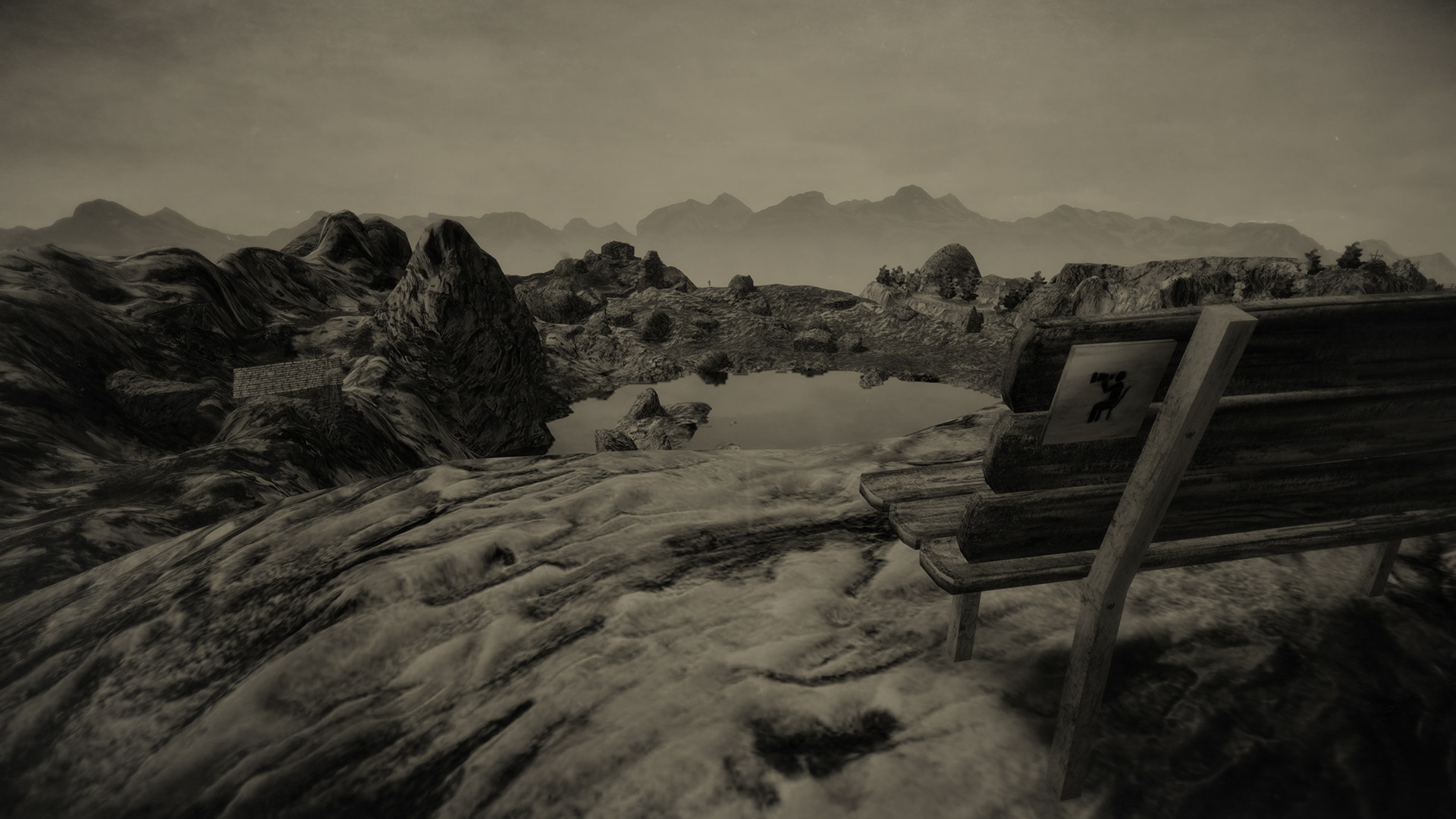
The art of the game has a combination of Two and 3 dimensional aspects, and is entirely in black and white. The overlay of 2-d textures heightens the uncanny valley often seen in 3-d video games.  The consistent  art style provides a feast for the eyes and increases the spook factor when a monster fades into view.

The atmospheric ambience  is achieved through the use of  rough textures of the mountain , while things like plants and animals are carefully detailed. By making the sky light grey and the mountains dark, there is just enough contrast to distinguish the two as you traverse the map.

The simplified human shapes of the characters lend credence to the appearance of the monsters. Having a simple style throughout  lets the player maintain their suspension of disbelief.

The story-book-esque style contributes to the games easy-going gameplay, with minimal stats to keep track of an the ability to run or avoid monsters. The game only has  a few jump scares, relying on psychological horror to keep you on the edge of your seat.

A pleasant vista
From the game’s STEAM page

How to make your own card game

How to make a card game from concept to completion

What do you enjoy in the card games that you play? What will entice others to play?

For this example, I tried to create a card game that my friends would play. They enjoy relatively simple games, that one can do while talking or conversing. I chose Uno to be the base game, as all agreed that that was their favorite game.

I like the aesthetic of tarot cards, so I also added in their number system (1-10, then page, knight, queen, and king).

I chose a theme, next. I enjoyed the tiktok trend of “vaguely terrifying beasts as pests that just bother you occasionally” as the theme, and boiled down their appearance to “Oblong form in mask”. Simplifying the appearance of the card’s design increases it’s readability. Making your images overly complex can confuse your players (or yourself when coloring them).

After deciding on those, it’s time to design the cards!

I chose to match the number of the figures to the number on the card, to keep it consistent visually. Other options include making the numbers of objects equal to the value of the card (ordinary 52-card deck), creating symbolism to match the value (most tarot cards), or even just putting the value of the card as the main focus (a-la- UNO).

Consistency is key to make sure the players can distinguish different groups of cards from each other while still recognizing it as part of the group.

Matching color-schemes or patterns is the common route to solve that problem!

For mine, each group (distinguished by color) has its own pattern as well. To make sure that all the cards -regardless of color- are read as from the same game/set, I used the same line-art for the base. Making all the figures the same helps tie the card set together.

The video has the rest of the process!

Good Society: a Jane Austen RPG

From Kickstarter project to off-the-shelf popular enough for a reprint, “Good Society” has come long way.

First released in 2018, funded by $154,774 Australian dollars from 2,677 backers,  it included a hardcover rulebook, between 20-36 cards (depending on how much you gave), and Pdf versions of the above.

Now, on its Storybrewer’s page, it offers one of its expansions in hardback as well, along with various expansion cardsets. The 280-page rulebook includes art and accompanying material.

The game is heavily focused on role-playing, which can be seen in it’s lack of numbered stats, and its LARP version that is also available to purchase. The traits used to navigate the game are the role you’re given, your family, desires, and your relationships.

Some unique aspects of the game:

    • NPCs printed on cards
    • Having a Game Master (GM/DM) is an option
    • Numerous Expansion packs ranging from servants to magic

Dungeon design in DnD: The Rooms, Hallways, and the bits between your players and the Boss

A home is not an empty house; even the most neat space still has stuff in it. In Dnd,  the problem is how to describe a space without tripping up your players, while maintaining the atmosphere you want.

Where is this place going to be? Will you build the building around the location? Will you develop the building based on its occupant? Both?

Think about what people would need to live in your chosen location. For example: A Cult that lives below ground; where do they get their food? What do they do for entertainment? What do they find important in their cult, and what kind of space does that occupy? In that case, you could add in pantries, game rooms, a few sacrificial alters in front of a statue with it’s own room, a space for priests in the cult, a space for digging tools, an area for certain building or support materials, and some sort of path to remove dirt that’s been freshly dug.

Even with just this, there’s already a map being developed.

To build a place around its occupants can be more complex than just location-based design. For example, If you have archers in your castle, you’d want the tall, thin windows and battlements that will protect them; however, non-European cultures tend to use mounted archers (those on horses) more often, so the buildings in those areas don’t account for defense-based archery.

More simply, you can examine the origin and design of your boss, and what pieces of architecture would accentuate those traits. an Eldritch beast would call for a dark and imposing building, with heavy materials, the tall ceilings oozing with foreboding shadows, and stained glass windows alluding to something far beyond the Players’ knowledge. There is also a need to consider the atmosphere you’re trying to create, and creating a moodboard (a selection of images associated with what emotions you want to convey) can help.

For the individual rooms, you can search up a list of items created in the era you wish (for more historically-inspired pieces), or a list of items found in books or media for the location (for sci-fi or high fantasy). You can also review your list of occupants and wonder about what they might need for daily life, and then scatter about these items.

To spice up the interior, you can add in Furniture! Use words that can describe the atmosphere or boss as well. The furniture a person has can tell you something about them. A “bone-thin chair with a black metal back” has a much different vibe than a “warm, plush couch, made of quilted velvet”. A visible lack of furniture can set up an atmosphere of barrenness, or even when placed in context, an air of suspiciousness.  Furniture can be minimalistic, decorated, homely, and can help set up your atmosphere as well as any sounds made by a you-tube playlist.

The materials used in the room can also give it flavor. Describing types of stone using their textures or appearances, or using the wallpaper to its maximum effect. Add in color-meanings or flower symbology to tell the story of the place or its inhabitants. How well-maintained are the rooms? Do people care about the place they’re in?

You can also Give clues about your Boss in main rooms. Shed skin for scaly beasts, the odd hair or piece of fur, or even a closet with the Boss’ preferred outfits. Does your Boss have a particular diet, or habits that are unique to their species or situation?

All of the above can be used to world-build in a way can be as subtle (or dramatic) as you’d like!

Have fun designing!